Jun 9, 2026
Georgia Tech Environmental Health and Safety (EH&S) is helping prepare the next generation of safety leaders through a newly launched Lab and Workplace Safety Certificate Program, a yearlong initiative designed to strengthen laboratory safety culture and promote proactive, people‑centered approaches to risk management.
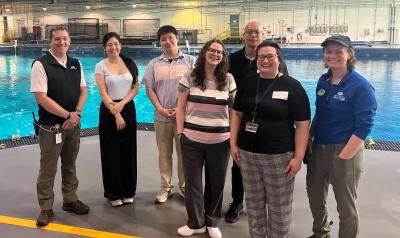
As part of the pilot program, Georgia Tech graduate students Megan Yutthasaksunthorn, Calib Lanier, and Youngsu Shin recently took a behind‑the‑scenes tour of Georgia Aquarium, gaining insight into how safety principles are applied in complex operational environments. The experience highlighted best practices in water quality monitoring, laboratory and workplace safety, and, most importantly, the role of a strong safety culture.
A Program Rooted in Industry Best Practices
The Lab and Workplace Safety Certificate Program was developed in collaboration with ExxonMobil’s laboratory safety program in Houston, Texas, bringing industry‑tested practices into an academic framework. Georgia Tech is participating alongside peer institutions, including Washington University in St. Louis, the University of Florida, and the University of Texas, reflecting a growing, cross-institutional commitment to advancing lab safety education.
The certificate is designed primarily for graduate students pursuing careers with a focus on chemical and process safety, though qualified undergraduate students may also be considered. Over the course of the year, participants complete both online and hands-on learning components, blending foundational knowledge with applied experience.
The goal of the program is twofold: to develop safer laboratory practices and to equip participants with the skills to train and influence others in lab settings. Rather than focusing solely on compliance, the program emphasizes leadership, communication, and systems thinking — key elements of a sustainable safety culture.
Hands‑On Learning Beyond the Campus Lab
The Georgia Aquarium visit was part of the program’s experiential component and offered a powerful example of safety in action beyond the traditional academic laboratory. Through a detailed presentation and tour, students learned how safety principles translate into daily operations in an environment where human performance, high‑risk activities, and complex systems intersect.
The visit was facilitated by EH&S Lab and Chemical Safety Officer Alicia Wood-Jones, who coordinated with an assistant dive manager of operations at the aquarium. The session included an in‑depth discussion on human factors and safety, an approach that asks a critical question: How do we design systems so mistakes don’t lead to injury?
This perspective resonated with students and reinforced one of the program’s central themes: Effective safety programs anticipate human error and build layers of protection through planning, communication, and shared responsibility.
Building Leadership and Safety Culture
Throughout the certificate program, participants engage in activities that strengthen both technical understanding and leadership capability. Hands-on components include:
- Delivering safety talks.
- Learning about safety culture in both academic and private industry settings.
- Conducting peer lab inspections.
- Engaging in dialogue around real-world safety challenges.
By examining safety culture across different environments, students gain a broader understanding of how values, behaviors, and systems come together to support safe work practices.
EH&S Leadership and Support
EH&S plays a pivotal role in supporting the certificate program and ensuring students have access to meaningful learning experiences that align with campus safety priorities. The initiative was spearheaded by Rebecca Graham, EH&S laboratory and chemical safety specialist, whose leadership and coordination helped bring the program and field experience to fruition. “It’s an honor to help lead this program and bring industry-informed practices, including those shaped through ExxonMobil’s safety framework, into an academic setting,” she said. “Our goal is to equip students not only with technical knowledge, but with the leadership skills needed to build and sustain a proactive safety culture wherever their careers take them.”
Through programs like this, EH&S continues its mission of fostering a culture where safety is proactive, collaborative, and embedded in everything we do.
For additional information about the certificate program, contact Laboratory and Chemical Safety Specialist Rebecca Graham.
Related Media
-
aquarium_ehs_graham_.jpeg